Hilo (formerly Aktiia) makes a consumer health wearable: a band that monitors blood pressure continuously through the day, a cuff used to calibrate it, and later Hilo Lens, a cuffless measurement taken with a phone camera. Thousands of people use it across iOS and Android, most of them managing or worrying about hypertension.
When I joined, the app worked, but it didn't really help. Users landed directly into a chart of their readings, split by day, week and month. It was accurate, clinical, and largely meaningless to most people. The first task I was given was to design an overview screen. What followed was two years of rethinking how people relate to their own health data, and the theme running through all of it was trust. People only keep using a health product they believe.
When the new device disagrees with the old one, people blame the new one
Users trusted the cuff, not the band
Everyone arrived with a cuff-at-the-doctor mental model: one reading, good or bad, done. When the band's continuous readings didn't match the cuff they'd used for years, the conclusion was immediate: Hilo is wrong. Support tickets and reviews said it in almost exactly those words.
Blood pressure is not a single number
BP moves naturally through the day: stress, caffeine, posture, exercise, time of day. Showing raw measurements without that context was producing anxiety and distrust instead of understanding.
Three data sources, one coherent picture
Users had readings from the band, a traditional cuff, and later Hilo Lens. These could differ for physiologically valid reasons, but any difference was read as the product being unreliable.
A genuinely new way to measure
Hilo Lens takes a cuffless reading from a finger placed on the phone camera. No established design pattern existed, camera placement varies across every Android handset, and the signal needs a warm, still finger to be reliable.
Six sources, one insight
I ran research through a community of 700 beta users, typically receiving around 200 responses per survey, and read everything else we had: customer-support tickets, Trustpilot reviews, community questionnaires, engineering drop-off data and usability sessions. The concept work asked whether people understood "time in target range", whether natural fluctuation felt reassuring or alarming once explained, and how they interpreted a difference between measurement types.
The complaints clustered. "It's different from my cuff" and "I don't understand calibration" turned out to be the same complaint wearing two outfits.
The calibration was creating the mistrust
Calibration is how the band learns your personal baseline: a cuff reading it can align its optical signal to. The original onboarding asked for one calibration, whenever you happened to set up. But blood pressure varies naturally, so a single reading at an arbitrary moment (after coffee, after the stairs, in a hurry) could easily be an outlier. The band then learned from a bad baseline, every later reading inherited the error, and the first comparison against a familiar cuff "proved" Hilo wrong.
So trust wasn't only a communication problem to be fixed with better copy. The onboarding was manufacturing a data problem, then asking users to trust the result.
Four calibrations, four days, and a reason to come back each day
I redesigned onboarding around the reality of variability: four calibration sessions across four days, spread across different times of day, so the baseline is an average rather than a snapshot. Then I designed the days in between to be worth showing up for.
Before a reading, the app now asks about caffeine, exercise, alcohol, food and smoking in the last 30 minutes (the European Society of Hypertension guideline), offers a five-minute relax timer, and shows short videos for positioning the band and the cuff, because placement errors were the most common cause of a bad first reading. After the first successful calibration, an accuracy card sets expectations directly: readings vary between devices and through the day, and that's normal.


Progressive disclosure: habits before blood pressure
Each day unlocks a little more. Day one shows the calibration ring and an education tile. Day two reveals sleep, steps and heart rate, the habits that shape blood pressure, before any BP number appears. Day three adds education alongside the data. Day four's final calibration reveals the full picture, with a single confetti moment. A progress ring, distinct encouraging copy for each day ("Just one more calibration to go, see you tomorrow") and a reminder scheduled after every calibration (re-sent at 24 hours, escalated to email at 48, cancelled the moment you complete) carried people through. Every calibration, education and insight event was instrumented in Amplitude so we could see where the journey leaked.
"As a new Hilo user I want to be guided through a four-day calibration process that progressively unlocks insights and education, so that I can understand my blood pressure and start forming daily habits with the Hilo Band." That's the user story the whole release was built around.


It doesn't stop at day four. Days five to nine introduce one feature a day (detailed time in target range, notes, medication reminders, the first weekly report, a daily sync reminder), each with a single coach-mark and one action, so the app grows at the pace a person can absorb. Calibration recurs every 30 days, and if a later calibration differs from the baseline, the app asks for a repeat within 48 hours rather than accepting the change unquestioned.
Shipped as Hilo 2.8, February 2026.


Before the journey: goals and motivation
The earlier onboarding I designed took a more declarative route. It asked "What is your primary motivation?" (a cardiac event, a kidney problem, a stroke, being a caregiver, family history, or optimising for longevity) and tailored the education that followed to the answer. Then "What are your goals?" branched into a measurement schedule ("Make better BP a habit": morning, afternoon and evening reminders by weekday), medication reminders, and a first lesson from the medical team.
By release 2.9 the goals screens were being retired: the four-day journey had taken over the job of building the habit, through action rather than declaration.


From readings to trends
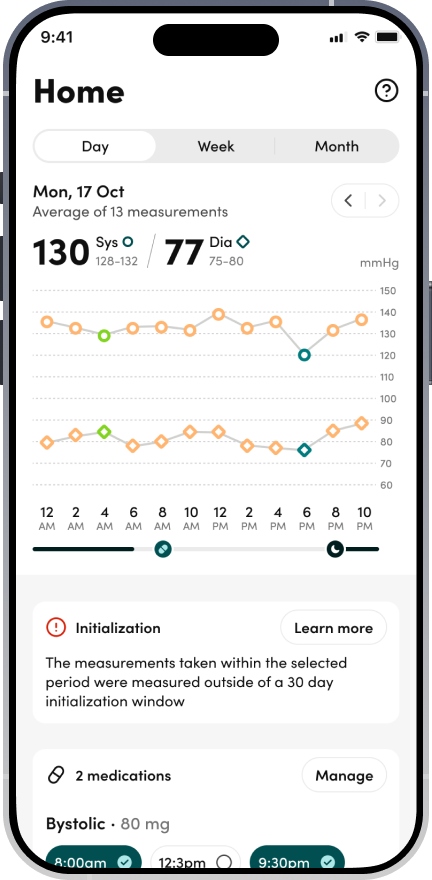
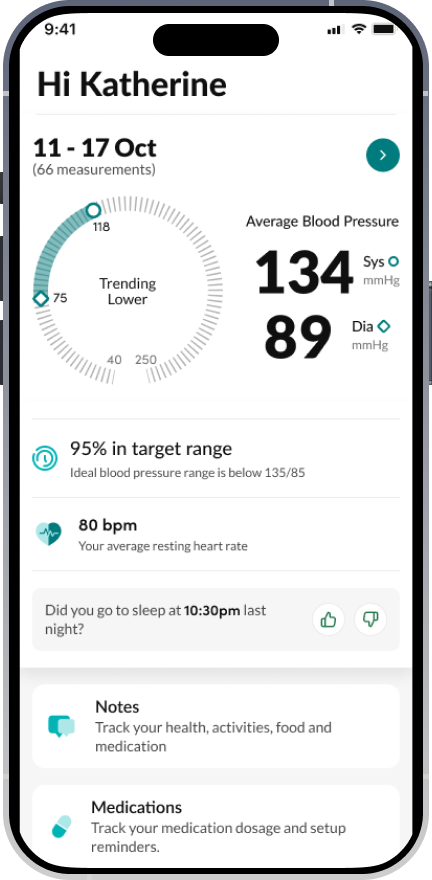
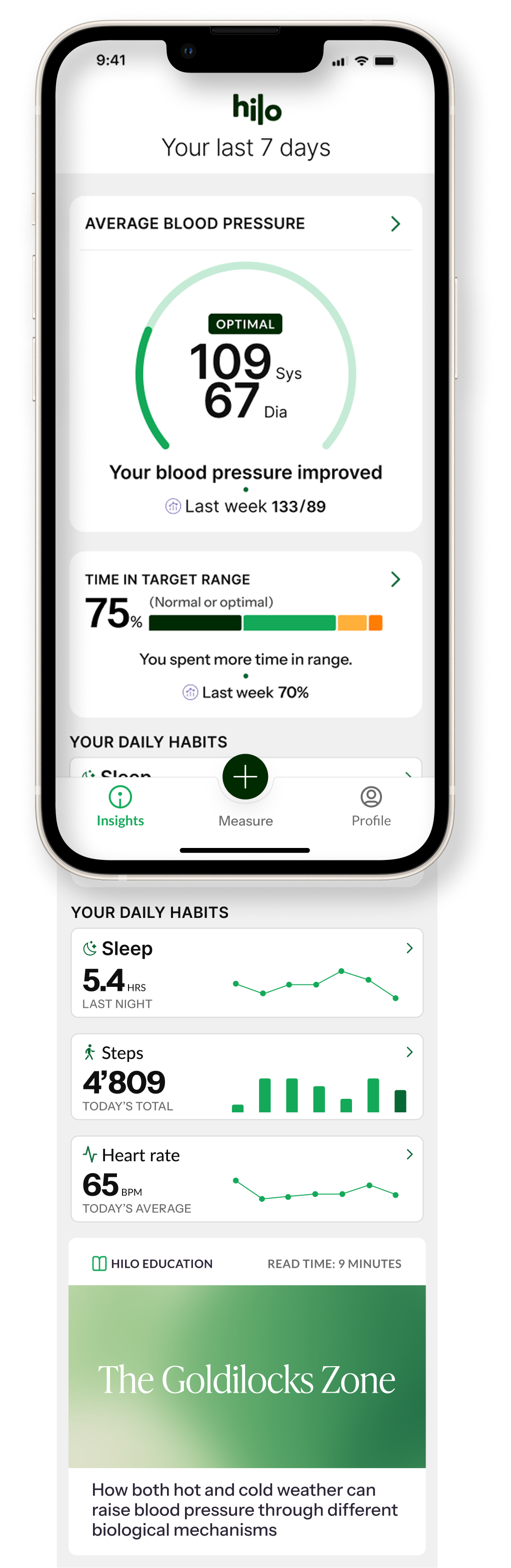
The overview I was hired to design replaced the raw chart with one metric: time in target range: the share of the day your blood pressure sits within a healthy range, calculated from two-hour windows and classified against the ESH categories. Unlike a single reading, it shows how consistently you're managing. Week-over-week trend states ("Your blood pressure improved · Last week 133/89", "You spent more time in range") turned numbers into direction.
Daily habits (sleep, steps, heart rate) sit beside the blood pressure metrics so people can connect what they did with what they measured. The point was never more data. Steps, sleep and activity had all been added before with no story connecting them to blood pressure: data silos instead of insight. The work I'm most proud of pushed the other way, distilling complex physiological data into one metric that changed how people felt about their own health.


Designing for the most constrained case first
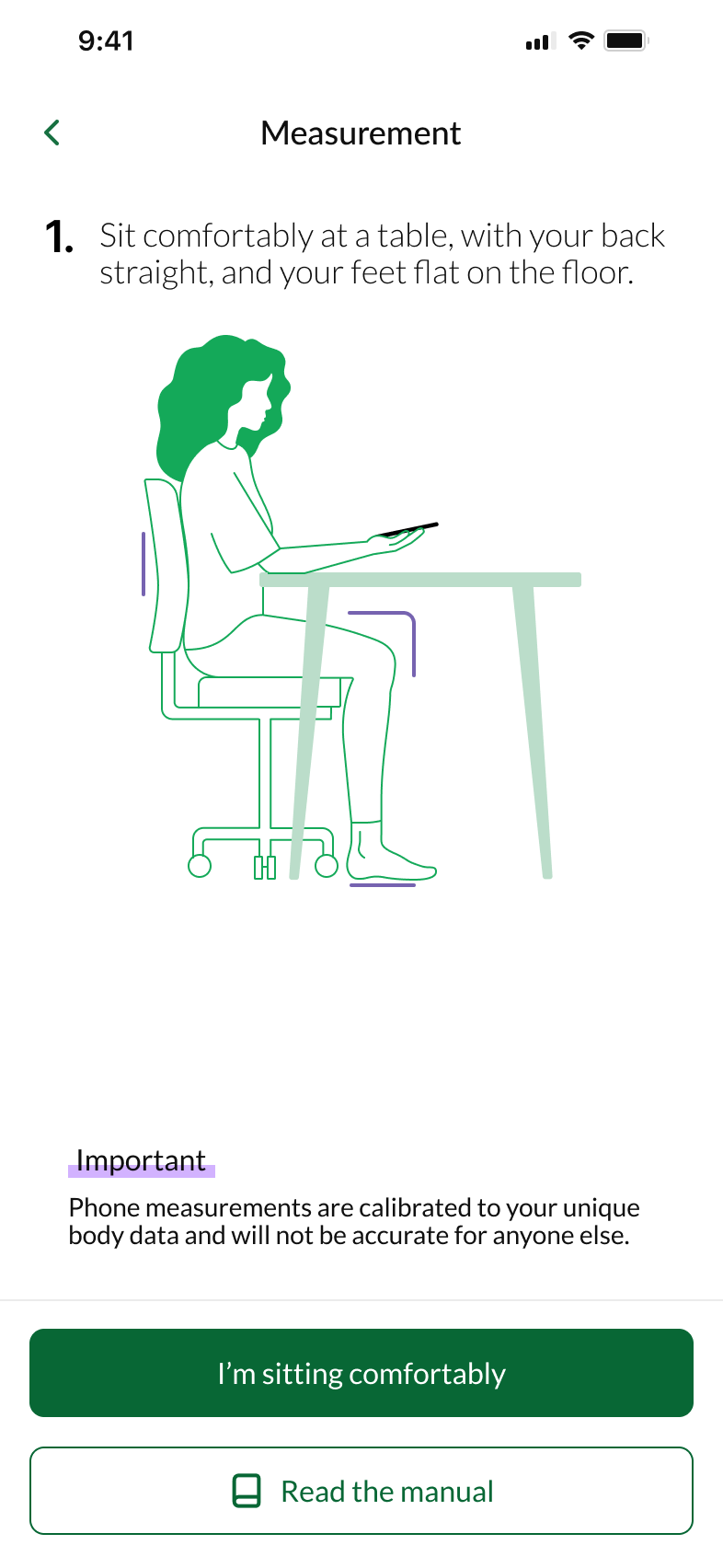
For Hilo Lens, I initially designed generic flows that worked across all Android handsets. Drop-off data showed consistent failure points: users couldn't reliably identify which lens to use or how to hold the phone. We made the decision to narrow scope: design specifically for iPhone first, using actual iPhone photography to show users precisely where to place their finger.
This felt like a step backwards. It wasn't.
Lens is also an exercise in designing around a model. The measurement is an inference from a camera signal, so the interface has to manage what the model needs (a warm finger, stillness, the right lens), show something honest while it computes, and diagnose the specific failure when it fails. Error recovery was designed iteratively: hand-warmth prompts, stillness cues with clear visual feedback, and step-by-step recovery screens that named the actual error rather than showing a generic failure state.
Designing for an algorithm that learns
Hilo shipped no AI-branded feature while I was there, and I'd rather say that plainly. What it had was an optical algorithm that converts reflected light into blood pressure, and a per-user model that calibrates to a personal baseline and updates it every time you calibrate. My job was making that learning legible ("your Band is learning your patterns", "we noticed a small change since your last calibration") and designing the insight layer that sat on top: time in target range, week-over-week trend states, education chosen for the person.
The questions I framed for the next phase were about making that layer adaptive: how might we make insights more personalised to individual baselines? How might we make insight messaging adaptive to the actual data, avoiding over-positive or generic language? Concepts I explored but didn't ship include a personal time-in-target-range goal, celebrating improvement rather than only flagging risk, and a blood-pressure zone score.
What shipped
Four-day calibration onboarding, release 2.8
Calibration rebuilt around blood-pressure variability, with progressive disclosure, a reminder loop and a days-five-to-nine feature drip. Shipped February 2026.
Hilo Lens shipped and iterated
A completely novel measurement interaction designed, launched, and refined, with a 70% reduction in drop-offs after narrowing to iPhone-specific design.
Full app rebrand across iOS and Android
A London agency delivered a name and some visual direction; I applied the brand to the app under time pressure, invented the Hilo Wave premium differentiator, and built the component library bridging Figma to engineering via Figma Make.
FDA application contribution
Usability evidence and design rationale submitted as part of the regulatory application, documenting that real users could use the product safely and effectively.
Promoted to Head of Design
Took on brand governance across product and marketing in July 2025, line-managing the brand designer and bringing in a creative director to align with the new CEO.
What I learnt
Trust is designed, not announced. No amount of reassurance copy fixes a baseline that was measured badly. The calibration work was the moment I stopped treating mistrust as a messaging problem and started treating it as a design problem with a data cause.
Give people value before you ask for patience. Four days is a long time to wait for the thing you bought. Showing sleep, steps and heart rate on day two, and saying so, made the wait feel like progress instead of a gate.
More data is not more value. Steps, sleep and activity all went into the app without a story for how they connected to blood pressure. The work I'm proudest of didn't add a metric, it chose one: time in target range, with the habits arranged underneath it as the explanation.
Constraint produces clarity. Dropping Android support for Lens temporarily felt like failure. It led to our best outcome. Designing for the most constrained, most common case first, then expanding, consistently beat designing for the general case.
Health behaviour doesn't change because the interface is beautiful. It changes when people understand what they're seeing, believe it, and have a reason to come back tomorrow. That's the problem I want to keep working on.